Thursday, 13 July 2017

Astronomy Object of the Week - No.5

It's been a while since the last Astro Object of the Week, but here it is! This'll be a little introduction to the variable star SS Cygni, located in the constellation Cygnus, the Swan.


First things first: SS Cygni is categorized as a lot of different things, including a cataclysmic variable star, U Geminorum type dwarf star, and dwarf nova. As a cataclysmic variable star, it will eventually trigger a Type Ia supernova. SS Cygni is a binary system consisting of a white dwarf and a red dwarf that are so close together that one revolutionary period is only a little over six and a half hours long.

Throughout its rotations, the white dwarf will accrete matter from its companion, a common characteristic of dwarf novas. These white dwarfs are also involved in periodic outbursts in which the luminosity will increases due to instability in the accretion disk, every seven to eight weeks in this case.

When the mass of the white dwarf is close enough to or over the Chandrasekhar limit (1.4 solar masses), runaway carbon fusion will occur and lead to a spectacular (yet morbid) display of colors.

Thursday, 6 July 2017

The Marsupials of Australia


Good day, mates! It's been a week since I got back from my trip Down Under and visited the Australian cities of Sydney, Melbourne, and Gold Coast and the New Zealand cities of Queenstown (South Island) and Auckland (North Island).

It was a wonderful trip in general, but one of my favourite places on my journey was probably the Gold Coast. Here, I got to visit the Currumbin Wildlife Sanctuary, where I met some of the cutest and most amazing animals in the world, including koalas and kangaroos. The collection of species at the sanctuary reflected the fauna of Australia as a whole and therefore a large number of marsupial mammals, which I'll be talking about today.

Marsupials are interesting as mammals since they only occur in the Americas and Australasia (Australia, New Zealand, New Guinea), and 70% of those 334 extant species are endemic to Australia. Some of the most widely known Australian marsupials are koalas, kangaroos, wallabies, wombats, possums, and Tasmanian devils. Placental mammals are very rare in Australia, and the dingo, another famous Australian animal, is not actually a native species.

 
The most iconic characteristic of marsupial species is that the young are carried in a pouch after birth. There are also differences in other anatomical structures, including the brain; the marsupial brain does not have a corpus callosum that connects the brain hemispheres as Eutherians do. The skull and skeleton are also different.

However, perhaps the most marked difference is definitely in the reproductive system, in both structure and gestation process. Pregnancy is very short, and the embryo is born in an early stage of reproduction, reducing the risks of long-term pregnancies. This newborn joey finds its way to its mother's pouch and latches onto one of the many nipples there, from which it will receive food and develop more fully to one day be able to live out of the pouch.

Now here are some cute marsupials for your viewing enjoyment!


Sunday, 29 January 2017

Harvard's Natural History Museum

I've done the Fossils event and currently am doing the Rocks and Minerals even for Science Olympiad. As a (self-proclaimed) expert on these topics, I've visited several natural history museums, including the LA Natural History Museum, which is absolutely incredible, and the London Natural History Museum, which is stunning. But I have to say that, for its size and collection, Harvard University's Natural History Museum is surprisingly wonderful.

The array of specimens at Harvard is amazing for a place less than half the size of the LA or London museums. Every single rock or mineral specimen, every single fossil that I had to know (and more!); Harvard had it all. And not only were the specimens present, but they were also in top condition. There is, of course, also the world's only exhibit of realistic glass flowers.

This last time I went, just about a week ago, I was still awed by everything that I had seen on a previous trip. It's definitely a place that everyone, especially if you're interested in geology, should take a trip to.

Thursday, 14 July 2016

Paint With All the Colors of the Rainbow


Joyeux quatorze juillet to anyone in France or who loves French culture (like me)! I'm not going to post Nematodes (Part II) quite yet.

So, I just started reading a book called Schrödinger's Cat by Adam Hart-Davis. It goes through different eras of scientific thought, listing out important scientific discoveries of each time period. I finished reading the very fast chapter, focusing on the ancient thinkers (before the Enlightenment, that is) yesterday, and I found one of the sections to be especially intriguing.

This section talked about Theodoric of Freiberg, a Middle Ages German clergyman turned scientist who attempted to explain why the rainbow was colored the way it was. His explanation was original and verified by experiment. The one big thing is that it was entirely wrong.

Theodoric believed the rainbow was not made of a continuous spectrum (red, orange, yellow, green, blue, indigo, purple). Rather, he believed there were four dominant colors: red, yellow, green, and blue. Red and yellow were "clear" or translucent colors; blue and green were "obscure" or opaque. 

He performed several experiments to verify his thoughts, such as passing sunlight through a glass prism and looking at the sun through a flask full of water so as to model a raindrop.


Somehow, Theodoric's conclusions turned out to be correct though his explanations had been all wrong. Still, he can be commended for using the scientific theory - proposing a hypothesis and then testing it.

Friday, 8 July 2016

Nematodes! (Part I)

So I am finally done with my internship and free to write! And since I spent a whole month at Caltech studying nematodes, I thought I'd give you guys a little introduction into what they are and what I did there.

Here we go: a nematode is a roundworm. Some are free-living (usually in soil) while others are parasitic. The species of nematode that is studied most often is C. elegans (Caenorhabditis elegans), which is also considered a model organism, meaning that it is easy to maintain and easy to work with. It is a free-living variety and has essentially been domesticated for the lab.

I, too, worked with C. elegans for the majority of my lab work. My project involved the ecology of C. elegans, particularly what food it prefers. In the wild, C. elegans dines on soil bacteria. In the lab, it usually eats a strain of E. coli called op50. The point of the project I worked on was to determine which bacteria the worms preferred, other than op50.

To be continued in Part II...

Tuesday, 24 May 2016

Getting Back Into Things

So I know I've been gone for a while, but it's almost the end of school (just two more days!) and I hope I'll be able to get back into things. I really want to start posting more often over the summer, though it may be a little difficult with my internship and whatnot. Anyway, I'm so glad to be back and I'm looking forward to lots of new posts!

Sunday, 5 July 2015

Astronomy Object of the Week - No.1

I decided to start a series on Astronomy objects, so here is the first one, HD 106906b!

http://thebeautyandartofs.wix.com/thebeautyofscience#!Astronomy-Object-of-the-Week-No1/c1my5/559962f20cf2efdf74ec69ee

Don't forget to subscribe to my other website and like my Facebook page!


Friday, 26 June 2015

Newton's Laws of Motion

Here's my new post on Newton's Laws of Motion. I tried to explain with examples and a little bit of humor (in my opinion it was), so please check it out.

Also, don't forget to subscribe to my other website and submit topics!

http://thebeautyandartofs.wix.com/thebeautyofscience#!Newtons-Laws-of-Motion/c1my5/558ddc530cf2711ebbcdf2ec

Thursday, 18 June 2015

Wednesday, 10 June 2015

New Site

Hi everyone,

I have a new site now at http://thebeautyandartofs.wix.com/thebeautyofscience. I was still be regularly posting here to let you know when there is a new post on my new website.

Also, don't forget to like my Facebook page at https://www.facebook.com/thebeautyofscience

p.s. I promise I will try to update more regularly!

Wednesday, 24 December 2014

The Basics of Quantum Mechanics

I'm finally back again for this new post! I'm going to be explaining quantum mechanics in the simplest way possible.

First, I will start of with some atomic theory history. In the early 1900s, Ernest Rutherford came up with the planetary model of the atom, which is the one that is familiar to us today, although it is incorrect. The model could not explain: the electron collapse problem, periodic trends, and atomic line spectra.

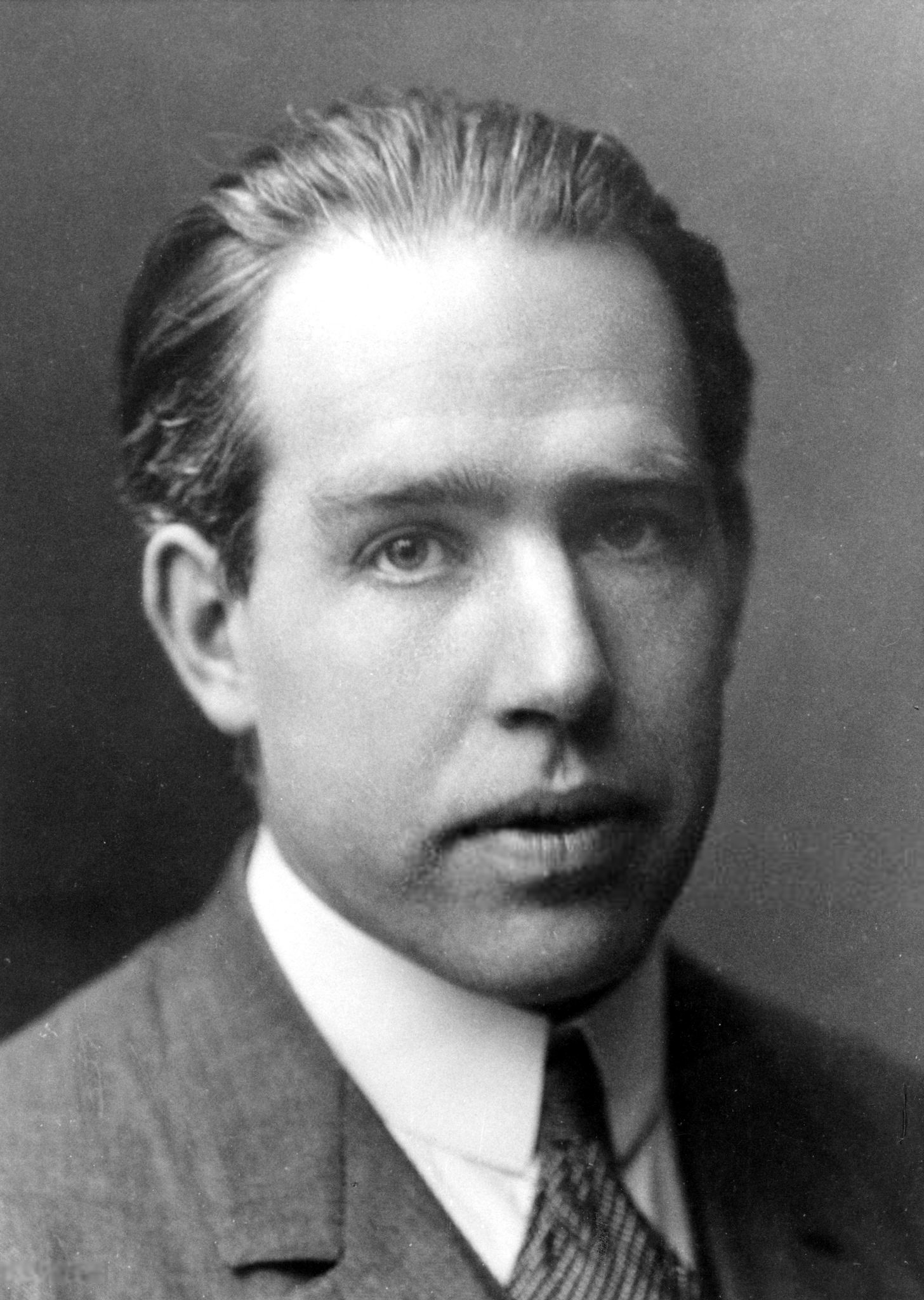
The Danish physicist Neils Bohr applied the newly developed quantum idea (Max Planck) to the hydrogen atom. The quantum idea states that light travels as a packet of energy called a quantum. The electrons of a hydrogen atom are found in energy levels outside the nucleus called shells, and the electrons could only be found in these energy levels. They would not fall into the nucleus. Energy levels were designated by the principal quantum number, n. Using this model, Bohr was able to explain the atomic line spectra for the hydrogen atom.

Unfortunately, the Bohr Model could only explain the atomic line spectrum for elements with one electron. The quantum mechanical model began to emerge.

Bohr Model of the atom
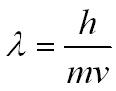
In 1929, Louis de Broglie derived the de Broglie wave equation. The wave equation could be applied to all systems, but is only detectable for very small objects.

The Heisenberg Uncertainty Principle states that it is not possible to know the exact position and momentum of an electron at the same time.

The Schrödinger Wave Equation describes the behaviour and energy of electrons. It is denoted by the Greek letter psi. Psi^2 is the probability of finding an electron in a particle region of space. This equation can only be solved for systems with one electron. All others are approximated. The solutions to the equation yields the quantum numbers, used to describe the most probable location of the electron in the atom.

I'm afraid that will be it for now
. In the next post (which will hopefully be in a few hours), I will describe the quantum numbers and laws associated with them!

Monday, 27 October 2014

Mole Day

Yes. I know Mole Day was a few days ago (October 23), but it isn't too late to celebrate!

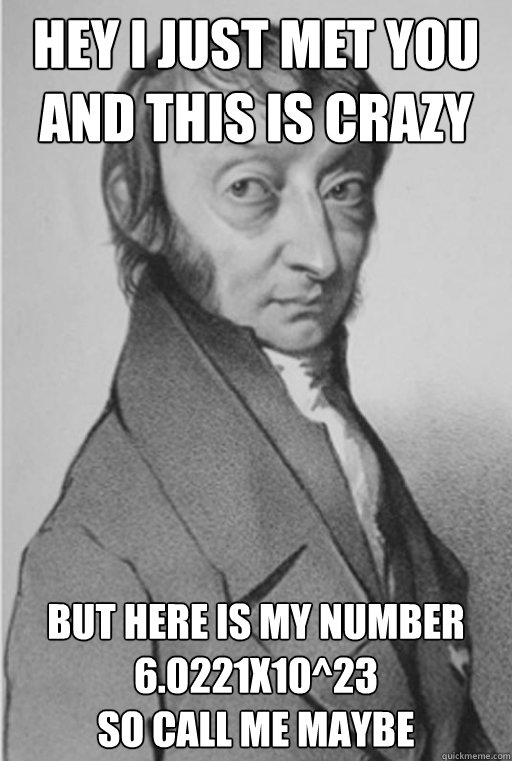
Mole Day was created in recognition of the amazing unit of measurement, the mole (6.022x10^23), also known as Avagadro's number. The mole was named in honor of Italian chemist, Amedeo Avagadro. (The picture below is just so funny!)

The mole is very important in chemistry, and it is 6.022x10^23 of anything. Imagine a book with that many pages!

With these few little facts, happy late Mole Day!

Wednesday, 25 June 2014

Methods of Fossilization

Sorry for not posting anything for so long! Now we're completely switching gears.

This time I'll be talking about methods of fossilization. Before that, though, I need to tell you some of the conditions for fossilization. It is very difficult for an organism to become fossilized, because the conditions are so specific.

Conditions for Fossilization:
1. Conditions are mild.
2. Composition of the organism is suitable for fossilization (usually hard parts, but not always).
3. Remains of the organism are buried quickly.

These are just some, not all of the conditions, but they will suffice for now.

The Methods of Fossilization:

Common Modes-
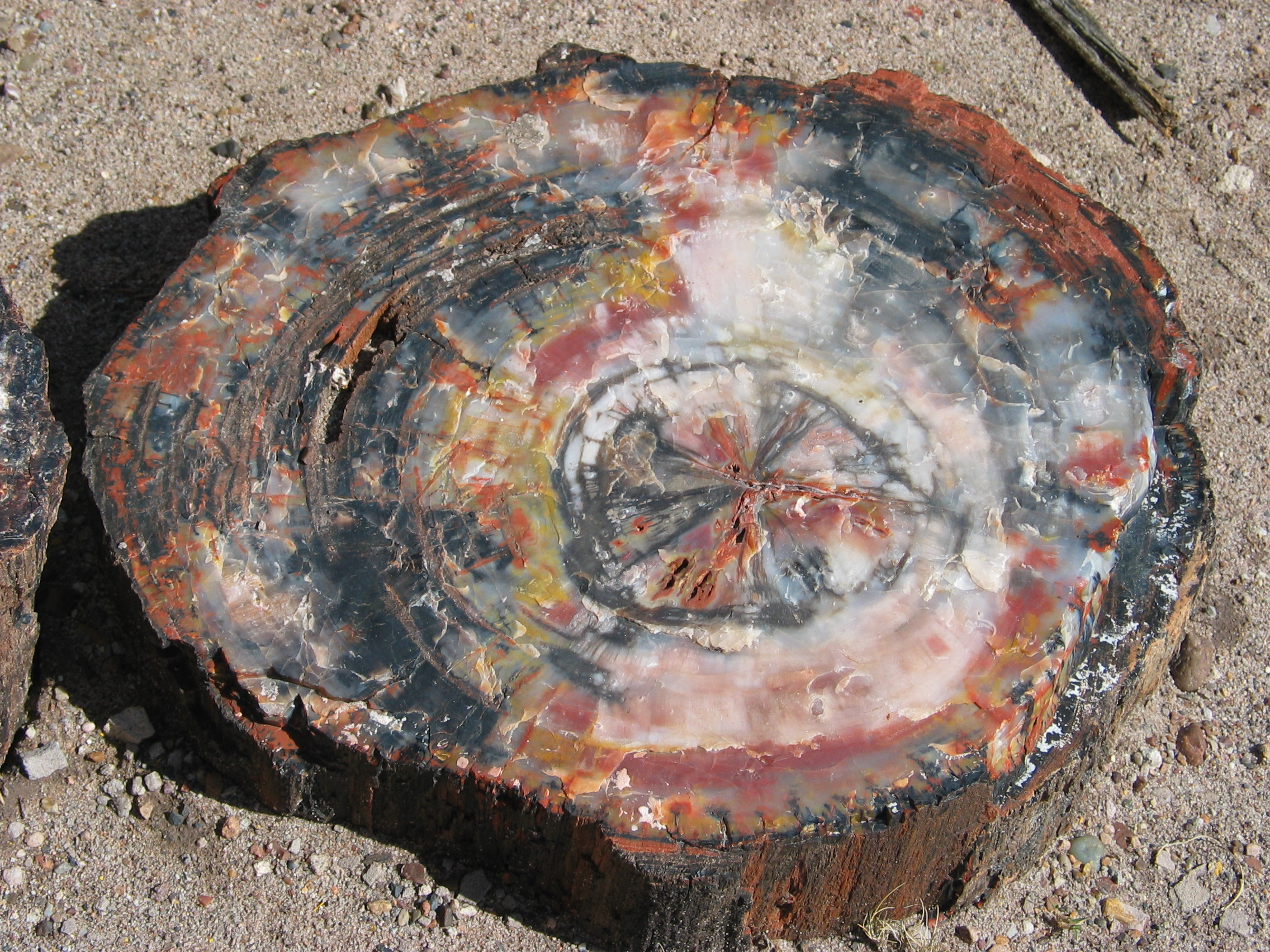
1. Permineralization: Minerals from a solution fill into pores in wood, shell, or bone that eventually harden. A specific form of this is petrification where organic matter is replaced by minerals and eventually turns to stone. A well-known example of this is petrified wood.


2. Mold: Imprints of an organism in rock.
    Cast: A replica of the original organism when the mold is filled with sediments or minerals. This is relatively uncommon.


3. Carbonization: Usually fossilizes plants and soft-bodied animals. Organisms fossilized as a carbon film in sediment.
May show great detail.


4. Actual Remains: Is what it sounds like. Organism's original body somehow survives.


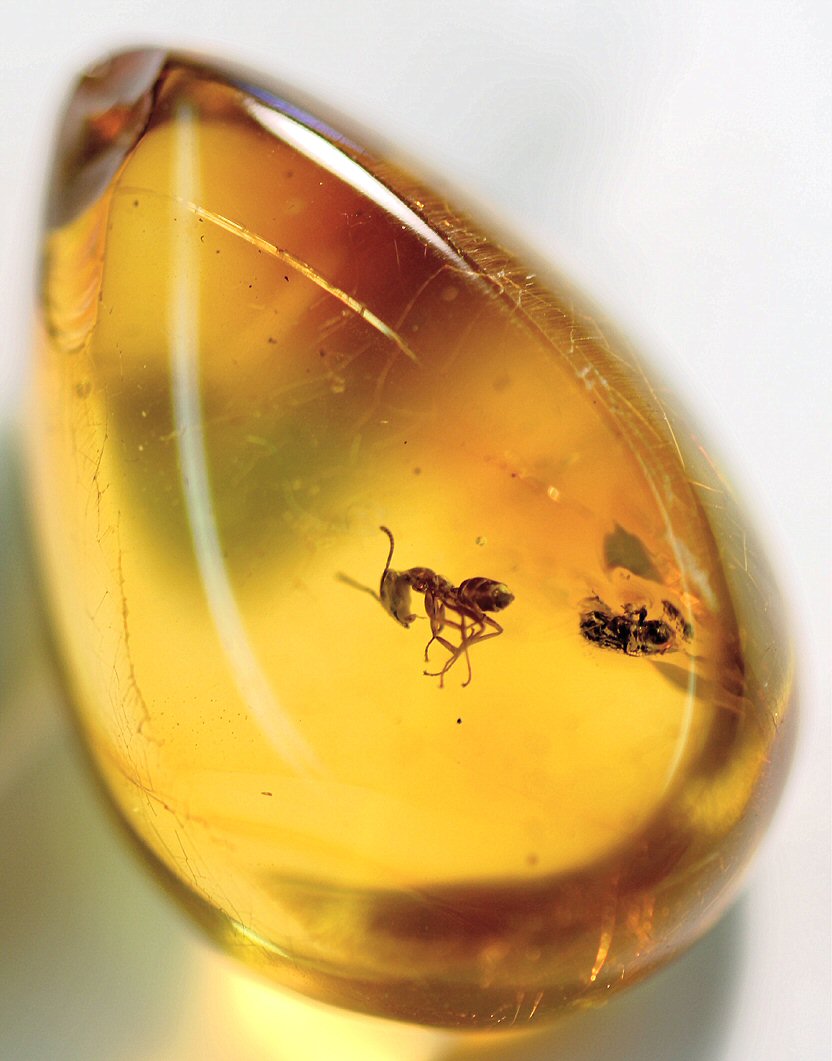
5. Amber/Copal: Organism is trapped in pine resin which turns into amber. Soft parts are fossilized.


6. Mummification: Just as it sounds. An organism is mummified in natural conditions.


7. Freezing: One thing that may cause mummification. Organism is frozen and preserved.


8. Entrapment in tar/asphalt: Organisms are trapped in tar or asphalt and preserved.


These are, of course, not all of the methods of fossilization, but some of the most common. The processes described here also take a very long time.