Showing posts with label Biology. Show all posts

Thursday, 6 July 2017

The Marsupials of Australia


Good day, mates! It's been a week since I got back from my trip Down Under and visited the Australian cities of Sydney, Melbourne, and Gold Coast and the New Zealand cities of Queenstown (South Island) and Auckland (North Island).

It was a wonderful trip in general, but one of my favourite places on my journey was probably the Gold Coast. Here, I got to visit the Currumbin Wildlife Sanctuary, where I met some of the cutest and most amazing animals in the world, including koalas and kangaroos. The collection of species at the sanctuary reflected the fauna of Australia as a whole and therefore a large number of marsupial mammals, which I'll be talking about today.

Marsupials are interesting as mammals since they only occur in the Americas and Australasia (Australia, New Zealand, New Guinea), and 70% of those 334 extant species are endemic to Australia. Some of the most widely known Australian marsupials are koalas, kangaroos, wallabies, wombats, possums, and Tasmanian devils. Placental mammals are very rare in Australia, and the dingo, another famous Australian animal, is not actually a native species.

 
The most iconic characteristic of marsupial species is that the young are carried in a pouch after birth. There are also differences in other anatomical structures, including the brain; the marsupial brain does not have a corpus callosum that connects the brain hemispheres as Eutherians do. The skull and skeleton are also different.

However, perhaps the most marked difference is definitely in the reproductive system, in both structure and gestation process. Pregnancy is very short, and the embryo is born in an early stage of reproduction, reducing the risks of long-term pregnancies. This newborn joey finds its way to its mother's pouch and latches onto one of the many nipples there, from which it will receive food and develop more fully to one day be able to live out of the pouch.

Now here are some cute marsupials for your viewing enjoyment!


Friday, 8 July 2016

Nematodes! (Part I)

So I am finally done with my internship and free to write! And since I spent a whole month at Caltech studying nematodes, I thought I'd give you guys a little introduction into what they are and what I did there.

Here we go: a nematode is a roundworm. Some are free-living (usually in soil) while others are parasitic. The species of nematode that is studied most often is C. elegans (Caenorhabditis elegans), which is also considered a model organism, meaning that it is easy to maintain and easy to work with. It is a free-living variety and has essentially been domesticated for the lab.

I, too, worked with C. elegans for the majority of my lab work. My project involved the ecology of C. elegans, particularly what food it prefers. In the wild, C. elegans dines on soil bacteria. In the lab, it usually eats a strain of E. coli called op50. The point of the project I worked on was to determine which bacteria the worms preferred, other than op50.

To be continued in Part II...

Wednesday, 21 May 2014

The Action Potential-An Electrical Signal

The nervous system is a wondrous thing. It is what makes your body function, gives you your senses, helps with that upcoming test, and more. The nervous system consists of the central nervous system, the brain and spinal cord, and the peripheral nervous system, everything else. We will focus on the peripheral nervous system for now.

Nerves (bundles of neurons) make up the peripheral nervous system. This system helps you receive external stimuli, such as when you touch something. These stimuli are received by neurons and transported to other neurons and so on until the signal becomes weak and eventually stops.

In order to understand these signals, we must first describe the neuron, a nerve cell. The neuron consists of four main parts. The cell body houses the nucleus and other organelles.  The dendrites carry signals to the cell body. The axon conducts signals toward and effector cell or another neuron. The myelin sheath, which only vertebrates have, makes a signal travel faster along the axon, because it has to jump around from the nodes of Ranvier, the only places on a neuron where a signal can be transmitted. The myelin sheath is a chain made up of Schwann cells. The synaptic knobs (in this diagram, the axon terminal) transmit signals from one neuron to another or to another neuron. A signal can only travel in one direction, from the dendrites to the synaptic knobs.

Neuron
The neuron is usually at resting potential, -70 mV (millivolts). The neuron's membrane keeps potassium and dissolved proteins (which have a negative charge) inside and sodium (positive charge) outside. Channels and pumps in the membrane also keep the charge stable at resting potential. Sodium-potassium pumps are a form of active transport. Sodium cells and forced out, and potassium cells are forced in. They move more sodium than potassium.

Finally, we can proceed to the action potential, also known as a nerve signal!
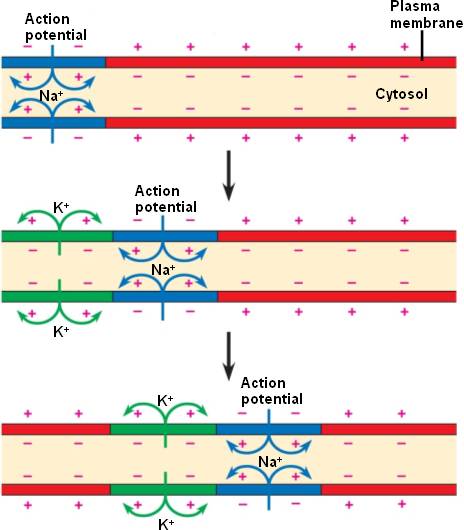
A neuron receives an external stimulus, and immediately the resting potential changes. The stimulus causes sodium channels to open, so the inside of the cell becomes more positively charged than before. If the threshold potential (-55
mV) is met, then an action potential is reached. More sodium channels open, and the inside of the cell becomes increasingly positive. This is called depolarization.
After the action potential is reached, sodium gates close, and potassium gates open. This causes the cell to become negative again. This is repolarization. There is a brief undershoot, because potassium channels close slowly. This is hyperpolarization. The cell is once again at resting potential.
The neuron will have short period where it is unable to receive another action potential. When an action potential occurs in one part of a neuron, it stimulates the next section of the axon and the next and the next. 
Propogation of an Action Potential Down an Axon
And now imagine. All of this has happened in just a few milliseconds!