Showing posts with label Physics. Show all posts

Thursday, 13 July 2017

Astronomy Object of the Week - No.5

It's been a while since the last Astro Object of the Week, but here it is! This'll be a little introduction to the variable star SS Cygni, located in the constellation Cygnus, the Swan.


First things first: SS Cygni is categorized as a lot of different things, including a cataclysmic variable star, U Geminorum type dwarf star, and dwarf nova. As a cataclysmic variable star, it will eventually trigger a Type Ia supernova. SS Cygni is a binary system consisting of a white dwarf and a red dwarf that are so close together that one revolutionary period is only a little over six and a half hours long.

Throughout its rotations, the white dwarf will accrete matter from its companion, a common characteristic of dwarf novas. These white dwarfs are also involved in periodic outbursts in which the luminosity will increases due to instability in the accretion disk, every seven to eight weeks in this case.

When the mass of the white dwarf is close enough to or over the Chandrasekhar limit (1.4 solar masses), runaway carbon fusion will occur and lead to a spectacular (yet morbid) display of colors.

Thursday, 14 July 2016

Paint With All the Colors of the Rainbow


Joyeux quatorze juillet to anyone in France or who loves French culture (like me)! I'm not going to post Nematodes (Part II) quite yet.

So, I just started reading a book called Schrödinger's Cat by Adam Hart-Davis. It goes through different eras of scientific thought, listing out important scientific discoveries of each time period. I finished reading the very fast chapter, focusing on the ancient thinkers (before the Enlightenment, that is) yesterday, and I found one of the sections to be especially intriguing.

This section talked about Theodoric of Freiberg, a Middle Ages German clergyman turned scientist who attempted to explain why the rainbow was colored the way it was. His explanation was original and verified by experiment. The one big thing is that it was entirely wrong.

Theodoric believed the rainbow was not made of a continuous spectrum (red, orange, yellow, green, blue, indigo, purple). Rather, he believed there were four dominant colors: red, yellow, green, and blue. Red and yellow were "clear" or translucent colors; blue and green were "obscure" or opaque. 

He performed several experiments to verify his thoughts, such as passing sunlight through a glass prism and looking at the sun through a flask full of water so as to model a raindrop.


Somehow, Theodoric's conclusions turned out to be correct though his explanations had been all wrong. Still, he can be commended for using the scientific theory - proposing a hypothesis and then testing it.

Sunday, 5 July 2015

Astronomy Object of the Week - No.1

I decided to start a series on Astronomy objects, so here is the first one, HD 106906b!

http://thebeautyandartofs.wix.com/thebeautyofscience#!Astronomy-Object-of-the-Week-No1/c1my5/559962f20cf2efdf74ec69ee

Don't forget to subscribe to my other website and like my Facebook page!


Friday, 26 June 2015

Newton's Laws of Motion

Here's my new post on Newton's Laws of Motion. I tried to explain with examples and a little bit of humor (in my opinion it was), so please check it out.

Also, don't forget to subscribe to my other website and submit topics!

http://thebeautyandartofs.wix.com/thebeautyofscience#!Newtons-Laws-of-Motion/c1my5/558ddc530cf2711ebbcdf2ec

Thursday, 18 June 2015

Wednesday, 24 December 2014

The Basics of Quantum Mechanics

I'm finally back again for this new post! I'm going to be explaining quantum mechanics in the simplest way possible.

First, I will start of with some atomic theory history. In the early 1900s, Ernest Rutherford came up with the planetary model of the atom, which is the one that is familiar to us today, although it is incorrect. The model could not explain: the electron collapse problem, periodic trends, and atomic line spectra.

The Danish physicist Neils Bohr applied the newly developed quantum idea (Max Planck) to the hydrogen atom. The quantum idea states that light travels as a packet of energy called a quantum. The electrons of a hydrogen atom are found in energy levels outside the nucleus called shells, and the electrons could only be found in these energy levels. They would not fall into the nucleus. Energy levels were designated by the principal quantum number, n. Using this model, Bohr was able to explain the atomic line spectra for the hydrogen atom.

Unfortunately, the Bohr Model could only explain the atomic line spectrum for elements with one electron. The quantum mechanical model began to emerge.

Bohr Model of the atom
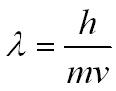
In 1929, Louis de Broglie derived the de Broglie wave equation. The wave equation could be applied to all systems, but is only detectable for very small objects.

The Heisenberg Uncertainty Principle states that it is not possible to know the exact position and momentum of an electron at the same time.

The Schrödinger Wave Equation describes the behaviour and energy of electrons. It is denoted by the Greek letter psi. Psi^2 is the probability of finding an electron in a particle region of space. This equation can only be solved for systems with one electron. All others are approximated. The solutions to the equation yields the quantum numbers, used to describe the most probable location of the electron in the atom.

I'm afraid that will be it for now
. In the next post (which will hopefully be in a few hours), I will describe the quantum numbers and laws associated with them!